
Whether you’re a seasoned writer, just starting your journey, or suffering writer’s block, we all get a little stuck from time to time. Read on to learn 11 ways to get unstuck and start writing!
1. Allow your writing to be terrible.
Seriously, the first draft should be, well, rough. In fact, make it your goal to write as much terrible writing as you can. This circumvents your brain’s mean little voice that tells you how much you suck. If you’re trying to suck, then you’re succeeding. The secret is, not all of it will be terrible, and the more you do it, the lower the percentage of awful will be. Joke’s on you, brain.
2. Read The Artist’s Way and do the program.
You will be consistently called out for your self-sabotage and blocking behaviors. You will ask yourself, “how important is as Artist’s Date, really?” You will feel invigorated as you list all of your past grievances with abandon. You will feel silly at times. But goddamn it if it doesn’t work. I found my copy at the Goodwill Outlet for 20 cents. I’m only on week 10, but it’s already helped me start writing again. I would gladly have paid full price.
3. Be open about how and where you write.
Of course, we all want to be tucked away in a private writing study, a window overlooking a stormy seaside bluff, a mug of coffee cooling on the desk by your laptop, a dozing cat curled in the armchair in the corner. But that’s just not always feasible. If conditions can’t always be ideal or idyllic, as writers, we have to adapt. You can’t wait for the perfect time and place to start writing. One of my favorite places to draft a story is on a walk in the woods near my house, using voice to text in a Google Doc on my phone. I get a lot of writing done that way, and the fresh air clears my head. It almost feels like cheating, like writing has to be harder. It doesn’t.
4. Stack your habits.
I’m actually not even done with Atomic Habits yet, and I’m already using this strategy to boost my productivity, not just in writing, but in work, health, and life admin. I have my morning coffee with my Morning Pages. I take my vitamins each day with lunch. I make my bed when I take my pajamas off. I write when I take walks. By combining something I always do with something I want to do, I’m creating new habits. And writing is a habit.
5. Be consistent.
Little and often make much. This isn’t exactly original advice, but the more frequently you write, the easier it is to write. You don’t have to write 2,000 words a day like Stephen King or go for 22 hours a day like Danielle Steel. Just try to write something as often as you can. Just a little snippet, a clever turn of phrase, a bolt of inspiration. No biggie.
6. Use writing prompts.
I do. When I started, it felt like I was stealing ideas. My imposter syndrome was so bad, I couldn’t even take credit for my own writing. But I kept using them, and wouldn’t you know it, I actually had some pretty great stuff come out of them. Sometimes you just need that extra nudge to get the juices flowing.
7. Write in “sips” instead of only “gulps.”
This past November, I put myself through the writer’s equivalent of hell week — I did NaNoWriMo. 50,000 in 30 days. Now that is one big gulp. Maybe not for everyone, but for me, well, let’s just say that, while I did win, it was a month before I started writing again. So even if you have a daily word goal, and even if that goal is ambitious, you don’t have to do it all in one marathon slog. Fifty words here, a hundred words there. Nice, refreshing sips. Gulp too greedily and you’ll dry your creative well.
8. Self-flagellation.
Kidding.
9. Free write.
Set a timer and just start moving your hand until it goes beep. Similar to what is done in the aforementioned Morning Pages, this is a great way to take a dip in the stream of your consciousness. You never know what jewels you might find beneath the current. It also has the added advantage of moving at a faster speed than your inner critic, so it’s a very effective way to unstick a scene or character you’re stuck on. Plus, most of it will be terrible. But remember, that’s you goal! (See tip #1).
10. Read something.
Allow yourself to be inspired by the beauty of another writer’s words, the brilliance of their imagery, their wisdom disguised in story. Then, try to imagine the worst possible version of it. That’s what the author started out with. Quite similar to that malodorous turd of a rough draft in your Google Drive right now. All writing starts out that way. The wonderful thing about editing (and EVERY great writer has great editors), is that it, in fact, can polish a turd.
11. Start in medias res.
It means “in the midst of things” and starting here can circumvent one of the biggest blocks in writing — the blank page. Trying to find the perfect beginning can be so daunting that your story never begins. But a little-known secret in the writing world is that you don’t have to write your story chronologically!
Okay, it’s not little-known. But despite this gem of wisdom’s ubiquity, I can’t tell you how many times I heard it as an English teacher: “I don’t know how to start.” Just start at the fun part, the part that made you excited about the story, that gives you the too-much-macaroni-sweats, that you would want to read. You can always work on the beginning once you have a better grasp of your story, essay, poem, screenplay, etc. Or maybe, just maybe, you won’t even need it.

12. As an apology for the self-flagellation suggestion, here’s a bonus tip: Get yourself a writing mascot. Mine is this early 80s Figment Plush from Disney.
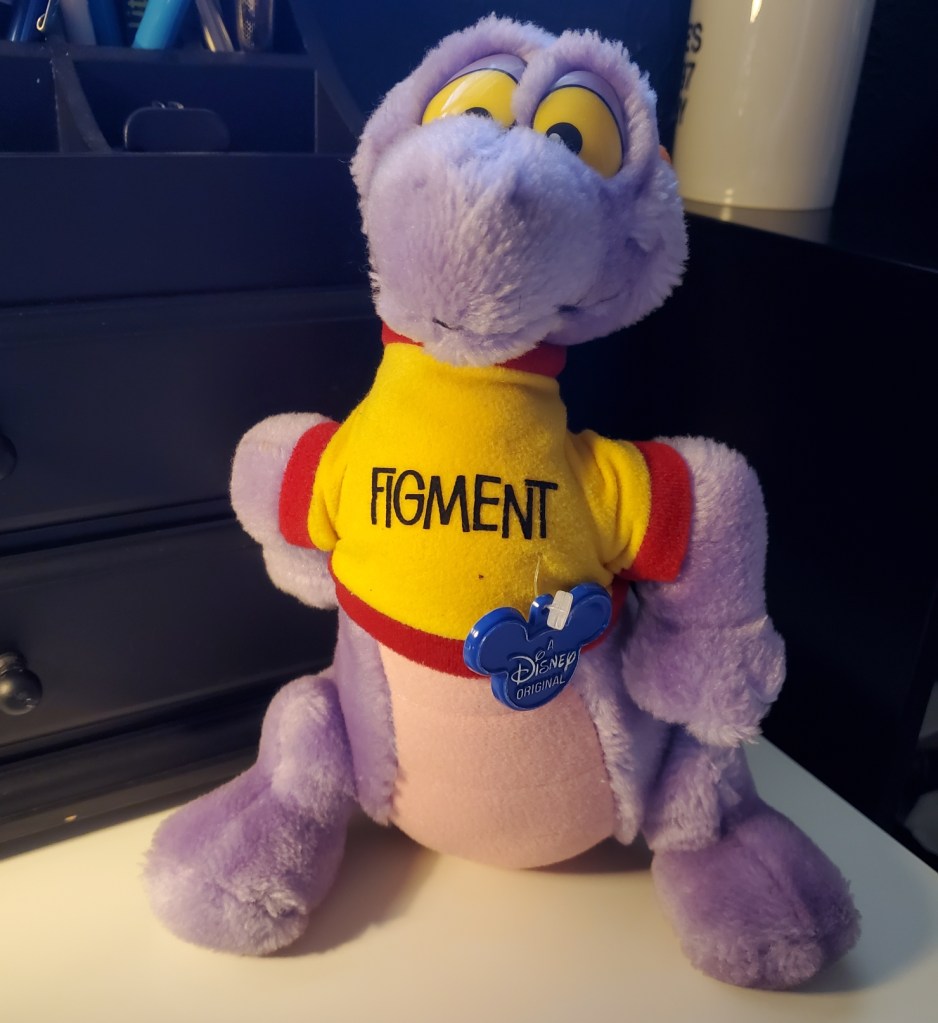
He embodies imagination, hence the name “Figment.” But I never called him that. When I was little, one day I called him Bebo, and Bebo he remained. Now Bebo’s my mascot, a cute little friend who watches over my desk, silently saying, “Go for it. You can write whatever you want. It doesn’t even need to be good.”
Let’s end with an inspirational quote:
“I will take care of the quantity. You take care of the quality.”
Julia Cameron
For me, “you” is the Dark Lord, a.k.a. the universe’s creative energy. For you it might be god, angels, Greek muses, Gaia… whatever floats your boat. However you name it, the point is, your job is to start writing and not worry about whether it’s good. That’s really not your problem. And certainly don’t worry about whether others will like it. That’s totally a them problem. (So, if you don’t like this blog, that’s on you.) All you have to do is write. The rest follows.
photo by Aaron Burden

 IFFY FICTION
Leave a reply to The Artist’s Way – IFFY FICTION Cancel reply