
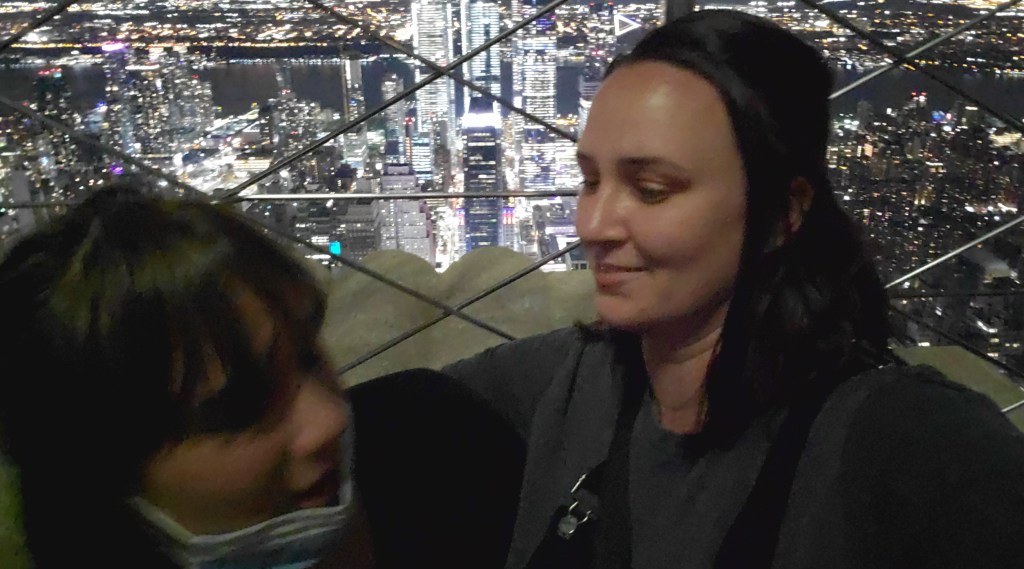
I plunged to my death in a past life.
As my knees trembled like a buckling bridge, I knew it must be true. It’s the only explanation. My head began to swoon as I stepped closer to the railing atop the stone barrier between the 86th floor and 1050 feet of sultry New York city air. I touched the metal grate, thin considering its duty. It felt slick with the humidity. Or maybe it was the sweat of my palm.
A throng of people stood around me, sat on the ledge beside, taking selfies, seemingly unconcerned with the precipitous drop mere inches from their backs, ready to swallow them, still smiling for the ‘Gram.
Distraction was key. I looked south at downtown Manhattan and the harbor beyond, trying to find our hotel by counting blocks away from the atomic glow of Times Square. The sun had set an hour before, but the city’s lights, legion and luminous, reflected off the low hanging layer of clouds. An eternal roseate purgatory, neither night nor day. No wonder this city never sleeps.
I bravely stepped toward the edge until the toe of my flip flops brushed the granite barrier, telling myself “do not count the inches between you and certain death. For 90 years, the wall hasn’t spontaneously disappeared.” I pressed my head cautiously through a large gap in the metal railing, which I’d learned hadn’t been added until 1947 — 26 years after the building’s completion. An uneasy thought.
If we could remember our births, I imagine this would be what it would be like. The fear of the gaping world, ready to receive us, falling, living, until eventually — splat.
From this height, the humans below, where we had stood half an hour before, were shadowy specks, flitting from one triviality to another, weaving gossamer lives.
A Spanish speaking woman stood her toddler on the ledge beside me, telling him “sonríes” as a man took their photo. So trusting of human precaution. I retreated back into the safety of the deck, and willed my knees to stop shivering.
“I’m bored.” My daughter looked at me from under a curtain of bangs, her oversized “divorced-dad” Hawaiian shirt pasted to her skin with sweat.
“Bored? Are you seeing this view?” I gestured toward the panorama with a glance, struck once again by the human tendency to build things that expedite the end of our short lives.
“I’m gonna go inside.”
“Stay off your phone,” I said to her back, her downturned face illuminated by the blue glow of the screen.
The woman had, thankfully, removed her child from the ledge and wandered off. A trio of teenage girls replaced them, also heedless of the doom behind them. As though they were immune. A momentary decision, a single mistake, l’appel du vide — the call of the void. I had felt it, too.
That’s what scared me the most.
In the museum on the 2nd floor, I’d learned the Empire State Building was designed by William Lamb, finished in 1921, and cost $40,948,900 to complete. That’s $1,173,521,021.45 in 2022. And I’d seen photos of the men who’d built it. Wall-sized, vertiginous images of workers, carelessly perched on soaring steel beams.
But I, a Google scholar, had researched the “other” history. The one we all wanted to learn. How many people in the building’s 90 years had jumped?
36. There was, of course, Evelyn McHale, “The Most Beautiful Suicide,” a necrophiliac’s wet dream who’d had the consideration to die artfully embedded in the roof of a car. And there was the first, the laid off worker who jumped before the building was complete, a harbinger of the market crash to follow.
But then there was Elvita Adams, the woman who, on December 2, 1979, had decided to take her life. She’d leapt from the deck where I now stood, only to be foiled by a gust of the very wind now whipping my hair. It pushed onto a two and a half foot ledge just one floor below, only a broken pelvis to show for her efforts.
I made my way to the north side of the deck, taking in the neat grid of streets, more buildings and the darkened void of Central Park behind, wondering what could be so bad that to leap from 1,050 feet would seem the better alternative.
Once I had seen every side and taken my obligatory, shivering selfies, I went inside. The profusion of lights began to blend into a blur that overwhelmed rather than dazzled. Desensitization followed. My knees had stopped shaking, and I discovered that I, like my daughter, had grown bored.
I found her sitting on the ground, folded up near an art deco garbage can, watching YouTube.
“Are you ready?”
“Yeah,” she answered, as though it was the stupidest question she’d even been asked.
After the ear-popping elevator ride down, and the wallet-writing tour of the gift shop, we found ourselves on the 34th street sidewalk.
I pointed up toward the 86th floor. “Can you believe we were just up there?”
Another shrug. I bristled, thinking of the $120 I’d just spent on such an underwhelming experience. “I can’t believe you were that bored.”
“I felt nauseous,” she said, rolling her eyes. “And I’m afraid of heights.”
There she was — eleven years old, nearly as tall as me. And already, I saw the budding fear that plagues us all, the fall that awaits, the inevitability.
But we’d made it through, living to fear another day, until fear normalized into tedium, and finally, resignation.
“Come on,” I said, putting my arm around her shoulder. She jerked herself free, and scowled, a gesture I was learning not to take personally. “Let’s go get a slice.”
 IFFY FICTION
Leave a comment